 Home page
Holsters
The following is a listing of the different holsters |
Catalogs |
Colorado SaddleryS.D. Myres
SafarilandMiscellaneous |
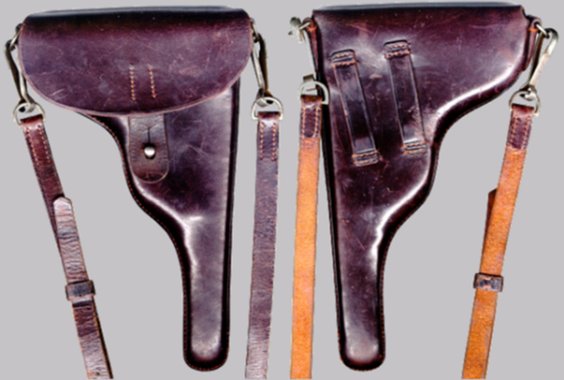
| ||
| Figure G1: 1900 or 1906 AKAH German commercial holster for 4-¾" barrel 30 cal Luger. Note the AKAH logo on the strap by mousing over the above picture. | ||
| | ||
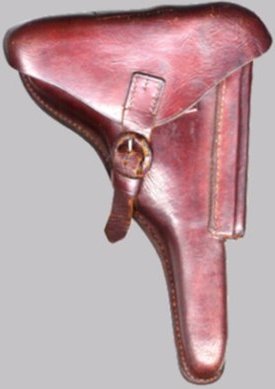
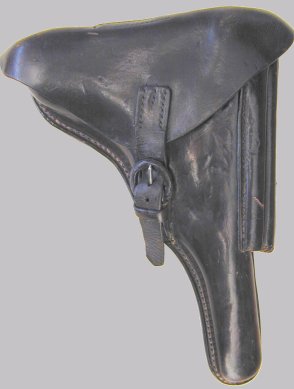
| ||
| Figure G2: 1906 style German commercial holster for 4-¾" barrel 30 cal Luger. (The holster shown on the left is featured in LUGER HOLSTERS AND THEIR ACCESSORIES by EU Bender, Copyright © 1992, p 263. Formally of the John Pearson Collection) Scan the mouse over the picture to view back side of holsters. | ||
| | ||
|
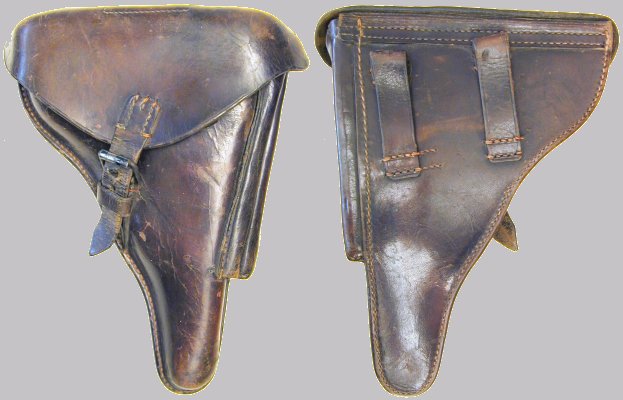
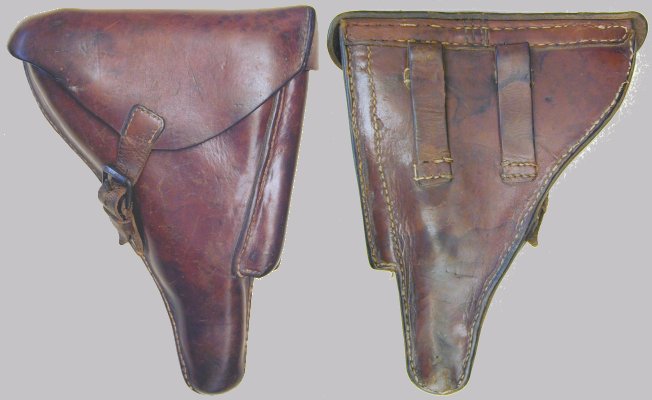
The following is a description of two very interesting P.08 style German
manufacture commercial holsters. The first example could be considered the
more standard. The leather color is dark brown. The holster body is rigid
with a magazine and cleaning rod pouch stitched to the spine and the body
has a leather "Pull up" strap for removing the pistol. The bucket flap is
secured to the holster body with a leather strap, belt buckle and belt loop.
Under the flap is a pouch for a tool and pin punch. The flap is secured by a
brass stud and slit. Two angled belt loops are stitched the rear holster
body. The holster body top edge and the holster flap edge have a piping
border. The stitching is excellent and is a red/brown color. On the inside
cover flap are two identical 3-line ink stampings and a hand written name in ink. The second holster is also dark brown and is mostly the same as the above holster with the following significant exceptions. There is no tool and pin punch pouch under the holster flap and there is no cleaning rod pouch stitched to the holster body spine, only a spare magazine pouch and the body lacks a leather strap for removing the pistol. The stitching is a bit coarser and a single stitching line is used on the top of the holster flap where a double stitch line is used in the first example. There are no piping borders or any stampings or marks whatsoever. The bucket style holster flap of the second example is stitched at the upper forward spine edge whereas the first example holster flap is a formed piece or leather at both corners. The back of the P.08 commercial holster is a single piece of leather being part of the magazine pouch back as well. The P.08 Commercial-Military holster back is separate from the magazine pouch. The magazine pouch and cleaning rod pouch are sewn onto the leading edge of the holster. Regarding the first example holster cited, some Imperial German officers were required to purchase their P.08 Luger pistols and holsters. The holsters were probably purchased privately which may explain the lack of a maker and date stamp. The 1st example holster generally does not have any military proofs or stamps yet are military issue and shouldn't be considered commercial, however a commercial, no date stamped P.08 Luger without the hold open device would be proper for this holster. The second example holster is clearly a P.08 style commercial holster of German manufacture of unidentified origins. It deviates from the military issue, as it doesn't comply with the accepted P.08 holster military pattern, lacking the loading tool/pin pouch and cleaning rod pouch. The holster more than likely is pre WWI and would be appropriate for a P.08 commercial or possibly a 1906 new model grip safety 4" 9mm Luger, which were manufactured up to 1914. | ||
| ||
| ||
| Figure G3: 2 P.08 commercial holsters. | ||
| | ||
|
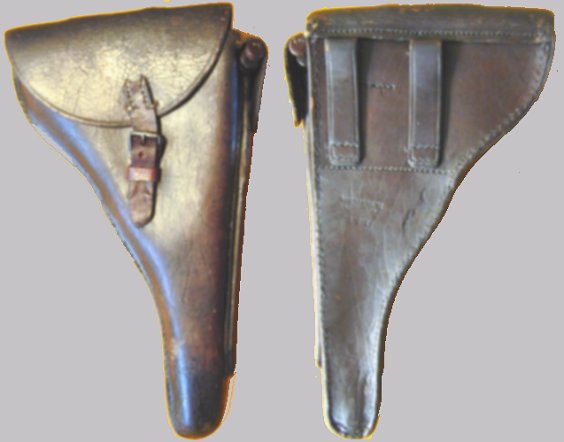
D6 Daniel F.J.Daniel, Bühl in Baden. This leatherwear manufacturer marked PT.04 and PT.08 in c.1910-18, most of which also bear ‘LZA Strassburg’ (q.v.). Daniel was originally believed to have traded in Suhl, through Bühl lies some 30km east north-east of Strassburg. (from The Luger Book by John Walters © 1986, p. 91) L67 LZA, L.Z.A. Found on pre-1918 PT.08, above a distinctive three-quarter displayed eagle clasping a sheaf of thunderbolts; significance uncertain. Several explanations have been forwarded for this mark, which is accompanied by a variety of stampings such as J. ERFURT. Disallowing unjustifiable explanations such as ‘Landespolizei-Zollamt Customs’, two remain: Landeszeugämter (Provincial Armories) and Leder-Zuweisungs-Amt der Kriegsrohstoff-Abteilung. The latter which is preferable, represents the ‘leather supply office of the war raw materials department’; this, it is assumed, supplied leather for completion by minor sattlers. Whether the leather was finished and pre-cut is debatable, though some holsters have been found on which the parts have been partly covered by the holster closing-strap. Known ‘LZA’ marks include ‘J.Erfurt’, ‘J.Barmen’ and ‘J.Breslau’; ‘H.Hamburg’ and ‘H.Strassburg’; and ‘Berlin. C.’, ‘Hannover’ and ‘Karlsruhe’’ without prefixes. The prefix ‘J’ probably represents ‘in’ (‘J’ being a regular substitute for ‘I’). However, ‘H’ remains a mystery; ‘Hauptamt’ is a plausible suggestion, on the basis that both Hamburg and Strassbourg were large towns. (ibid, P. 157) Shown in Figure G1 and referred to in IMPERIAL LUGERS AND THEIR ACCESSORIES by J. Still © 1991, P. 189, as a second variation holster with buckle closure and belt loops. The author also stated that the second variation holster was worn by naval ground forces in fighting in Belgium. | ||
| ||
| Figure G4: Second variation holster worn by German naval ground forces in fighting in Belgium. | ||
| | ||
|
H33 HKO On pre-1918 PT-08 and magazine/ammunition pouches. HK O OVER MÜNCHEN has been reported on Bavarian holsters, in conjunction with a very distinctive crown above ‘I’, ‘II’, or ‘III’. The ‘H’ and ‘K’ are conjoined to form a semi-monogram, in which, perhaps surprisingly, the ‘O’ plays no part. At the time of writing no satisfactory explanation of these marks have been offered.
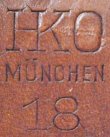

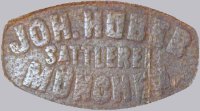
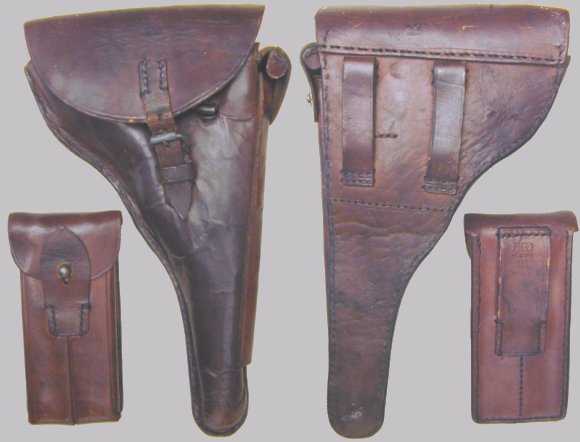
H60 Huber (ii) Joh. Huber, München. Nothing has been discovered about this maker of Pistol 1904 and P.08 holsters (1915-18), saddlery and ammunition pouches. The business apparently failed during the first years of the Weimar Republic. ------ from The Luger Book by John Walters © 1986, p. 137 The featured twin belt loop holster and magazine pouch for the M1904 navy Luger seems to fit most of the above information and additionally seems to connect the two "manufactures", Huber and HKO by way of the commonality of the crown I stamps and the fact that the crown I stamps were on the leather stock before it was cut. The holster is for the M1904/08 or M1904/14 (1916-1917 dated) navy Lugers, is made of a rich dark brown leather and has a cleaning rod pouch sewn on the leading edge holster spine with a cover flap secured by a steel stud and slot with small circular leather end caps. On the holster body is a pull-up strap. Under the holster body flap is a tool pouch with a cover secured by the same slit and steel stud method. On the rear of the holster in an oval cartouche is the maker "JOH.HUBER - SATTLEREI - MÜNCHEN" and to the right, partially obscured by the top of the belt loop is a very stylized crown over the Roman numeral I. On the front of the holster body, centered at the top is the same stylized crown over I. There are no other marks on the holster. The twin magazine pouch is in excellent condition and is made of the same rich dark brown leather as the holster. The cover flap is secured by the slit and stud method with the same style but slightly larger steel stud as the holster cleaning rod and loading tool pouch. On the rear belt lop is a very crisp, stylized stamping in three lines "HK O - MÜNCHEN - 18" and to the immediate top right of the single, wide belt loop, on the magazine pouch body is stamped with the identical, very stylized crown over I and a second crown over I is located on the left top edge of the magazine pouch body. The left edge of the crown is partially obscured where the back of the pouch is sewn to the front section. Both the magazine pouch crown over I stamps are identical to the holster crown I stampings. | ||
| ||
| Figure G5: M1904 navy Luger holster. | ||
| | ||
|
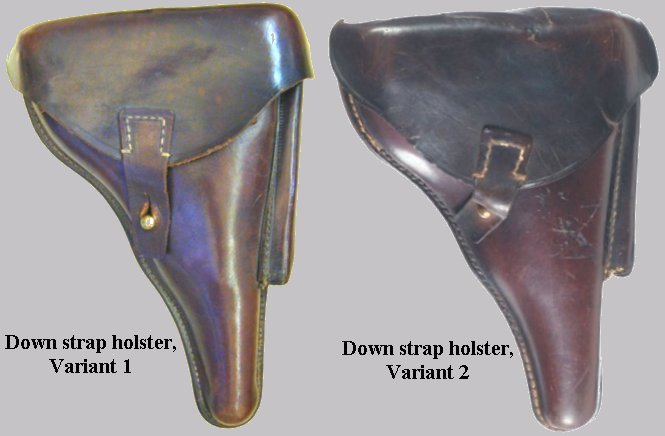
Featured herein are two pre-1925 commercial Luger “down-strap/stud” style holster variants identified as holster variant number 1 and 2.
At first when holster variant number 1 was acquired it was thought to be a “one off” commercial holster, dismissed as non-German manufacture and of poor quality construction.
Since the above “critique” another similar holster, no doubt made by the same manufacturer, identified herein as holster variant number 2 has been discovered that requires a reevaluation of the above critique. For a more detailed discussion of these holsters, refer to the following article "Pre-1925 Commercial Luger “Down-Strap/Stud” Style Holsters."
| ||
| ||
| Figure G6: Pre-1925 Commercial Luger “Down-Strap/Stud” Style Holsters. | ||
| | ||
|
Offered is an original German Artillery Luger holster that was period converted to belt wear for a Naval Artillery (LP08) Luger. The modifications include removal of cleaning rod sheath, rear stock block, keeper strap and closure strap. Added are a standard closure strap and buckle and a belt loop. This exact holster was featured in Bender's "Luger Holsters & Accessories..." on page 259. The original maker's mark remains in part: "F.H.Txxx, Magdxxxxg, 1918". All stitching is in place and strong, the leather hinge is complete and intact with two small weak spots (holes) no larger than 1/16 inch.
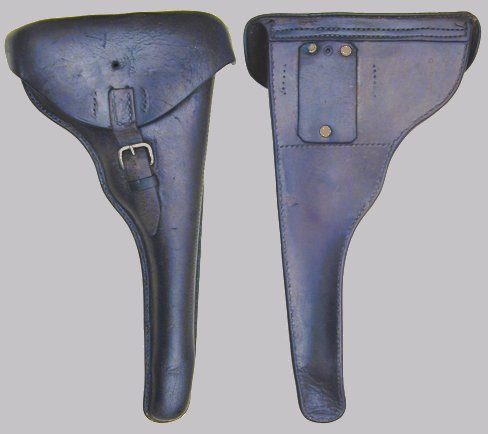 Figure G7: 1915/16 German Artillery Luger Holster. The above comments are from the EBay auction description of which the subject holster was acquired. The EBay seller has expanded on the description as originally featured on page 259 in E. Benders book "Luger Holsters and Their Accessories of the 20th Century". A detailed external and internal examination of the subject holster has revealed yet more secrets that require a further expansion of the description and a possible different direction or alternate scenario of the ultimate purpose or use for the conversion. The subject Artillery Luger holster belt loop configuration is however, a typical Weimar conversion. In the original description in Bender’s book, no specific statement was made that this holster was modified for a "Naval Artillery (LP08) Luger", which was added by the EBay seller. The original caption title simply states: Naval Artillery Holster Conversion. The Artillery holster has been modified two times since its original board/stock configuration. The second configuration consisted of changing to a simple strap and brass stud closure. The original "up" securing strap sewn to the holster body was kept and a brass stud was installed/added in the mid section of the holster flap with a belt loop added to the rear of the holster body. The current or third configuration consisted of replacing the holster body "up" securing strap with a belt buckle and hook, removing the holster flap brass stud, added in the second configuration and removing the perpendicular securing strap loop or "keeper strap" and sewing a pull down strap to the holster flap, which could have been the original strap attached to the holster body. As to whether the earlier added holster belt loop was changed is not certain, but since the second and final holster configuration used a belt loop it probably was not changed. The cleaning rod leather sheath was also probably removed at this time. Under the flap, located on the rear holster body is a Bekleidungsamt des Armeekorps or Army Corps clothing depot marking "B.A.III.", indicating this holster was originally issued through a clothing depot to a German army unit.1 With an original stated manufacturing date of 1918 this holster would have seen little service in WW1, however a closer look the manufacturing date it appears to be 1915 or 1916, not 1918. The modification from a shoulder strap board/stock Artillery Luger holster to a belt loop conversion probably occurred immediately after the war or in the early 1920s Weimar era, but not to hold a NAZI navy marked Artillery Luger based on the following observations. When inserting a 200mm barrel length Artillery Luger in this holster with the muzzle resting at the bottom of the toe with the holster flap closed, none of the holes in the belt strap will engage the buckle hook. In other words the holster flap cannot be secured to the holster body. The Artillery Luger seats properly in the holster body thereby dismissing any shrinking of the leather. There is no doubt, however, that as originally manufactured, with the original stud and slit method, an Artillery Luger fitted correctly. The question remains as to what model Luger fits this holster in its current configuration, which would possibly determine the purpose of the holster conversion. The answer is surprising. Examining the holster, again, in great detail revealed some unusual internal indents, indicative of long term storage of a Luger. The indents were two very strong, deep parallel lines located in the upper holster body leading edge internal wall, opposite the removed cleaning rod pouch. These parallel line indents as it turns out, align perfectly with the upper protruding ribs or walls of a 100-200 meter adjustable rear sight of a regular 150mm barrel P.04 navy Luger. When a regular navy Luger is inserted into the holster the two walls of the rear sight aligns perfectly with the indents. Additionally a P.04 navy pistol seats a little deeper in the holster body, allowing the holster flap to be closed securely with a strap hole engaging the belt buckle hook. Therefore the intent of the holster conversion was to house a regular navy Luger, probably a 1916 or 1917 chamber dated short frame variation. Further evidence that substantiates the Luger holstered was a regular 150 mm barrel navy Luger is a crease near the end of the toe, conveniently located dimensionally at the muzzle end of a 150mm navy Luger barrel, approximately 50mm from the holster toe. The crease created as the result of a lack of support of the lower 50 mm body section of the holster toe that would be provided by a 50mm longer Artillery barrel Luger. This crease is evident in the original picture of the holster as originally featured in Benders book. The silhouette or contour of a 150 mm barrel navy Luger is clearly evident on the rear of the holster body. 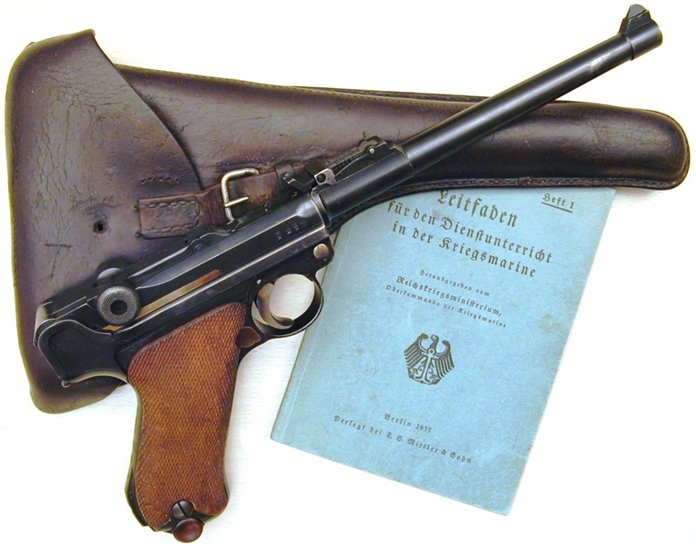
It is still possible that the holster was originally modified for an Imperial Artillery NAZI gripstrap marked Luger, shown above, but not very likely as such modified Artillery holsters would be expected to have a crown M navy or NAZI navy stick wing inventory inspection stamp.
| ||
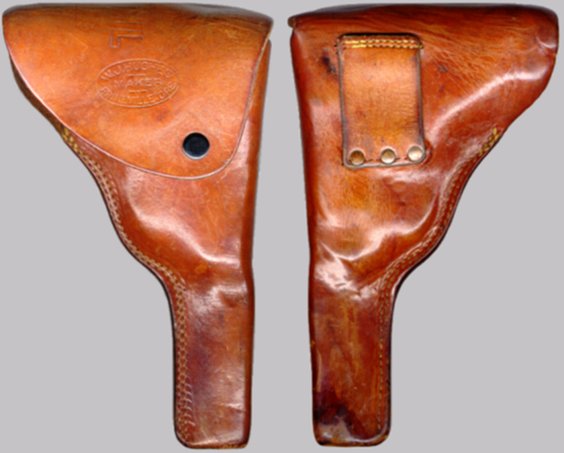
Featured below in Figure A1 is a very unique M1900 Luger style American Commercial holster. The logo of the maker W.J.HUGHES --- MAKER --- PRINEVILLE, ORE. is stamped in an oval cartouche on the front of the flap along with an even more unique "Cattle Brand" stamp  on the flap above the makers name. The leather used is russet cowhide. The back side has a single belt loop sewn at the top and secured to the holster body at the bottom with sewing and three copper rivets. The flap is secured to the holster body by a snap, manufactured by "UNITED CARR". on the flap above the makers name. The leather used is russet cowhide. The back side has a single belt loop sewn at the top and secured to the holster body at the bottom with sewing and three copper rivets. The flap is secured to the holster body by a snap, manufactured by "UNITED CARR".
| ||
| ||
| Figure A1: M1900 Luger style American Commercial holster. | ||
| | ||
| ||
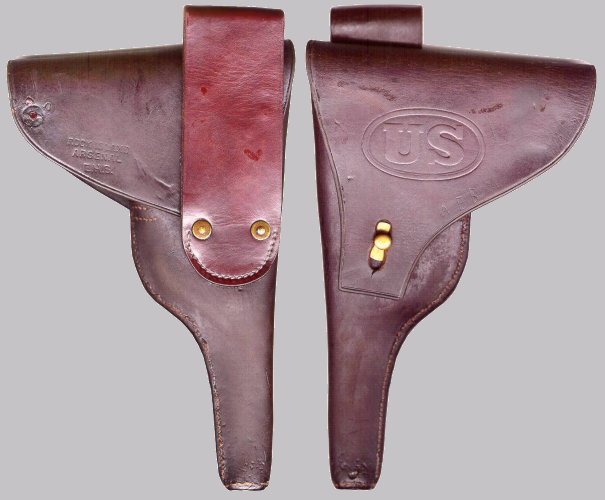
| Figure A2:
A genuine, original U.S. Army Test Eagle Luger holster. The rear belt loop may have been replaced. The front holster body brass stud has been re-anchored to the holster body by adding a brass washer. The holster body has been re-stitched. The original tan color of the Russet Leather is mostly gone due to excessive application of oil or leather preservative. Despite all of the mentioned changes and modifications the holster is a genuine, original U.S. Army Test Eagle Luger holster.
Run the mouse over the picture of the holster to see a close up of the rear of the holster showing the Rock Island E.H.S. stamp which is the inspector’s initials. | ||
| | ||
| ||
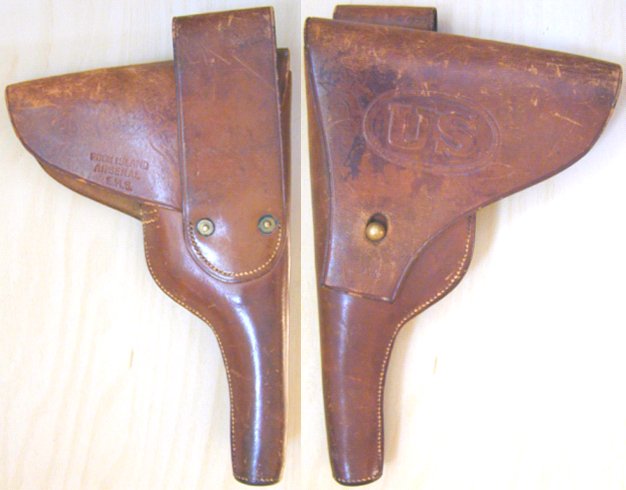
| Figure A3:
This U.S. Test Eagle Luger Rock Island Holster is in exceptional condition and the holster has been with the U.S. Test Eagle Luger pistol since it was issued in 1901. This has been determined by a close examination of wear patterns found on the pistol and holster that are unique to each other. There is a circular indent in the right side wooden grip that coincides in location and diameter with a protruding rivet on the inside surface of the holster body that aligns exactly with the grip indent with the pistol fully holstered and the flap secured to the holster body. The characteristics of the inner circular indent, with the hatching pattern worn smooth and the slightly uneven worn area surrounding the indent suggest that the main depression wear was incurred by long term storage and the outer uneven outer circumference wear by a constant minute shifting of the pistol in the holster, the latter a direct result of the holster and pistol being worn by a horse mounted U.S. Calvary soldier. The loose or protruding rivets are a result of stress encountered by the constant tension or jostling of the weight of the holster body and pistol against the belt loop being applied while being worn by a rider on a horse, i.e. again the U.S. Cavalry. Run the mouse over the picture of the holster to see the details described above. | ||
| | ||
|
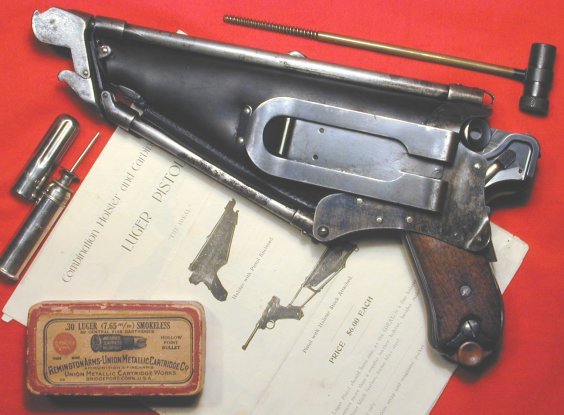
Figure A4 shows "The Ideal" combination holster with telescoping stock
for the Model 1900 or 1906 Luger, commercial or American Eagle. Featured is
and original combination rig with holstered 1900 American Eagle Luger, an
original, early pre-1910 Hans Tauscher full page flier advertising the Ideal
rig, period box of ammunition and combination cleaning rod/oiler.
| ||
| ||
| Figure A4: "The Ideal" combination holster with telescoping stock with holstered M1900 early 4 digit serial number American Eagle Luger. | ||
| | ||
| ||
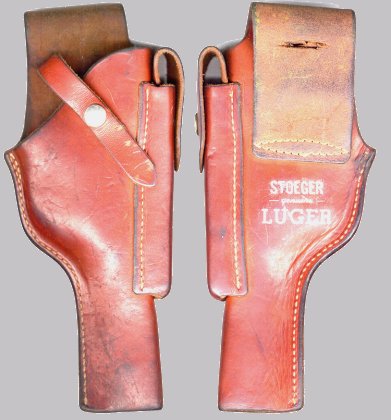
| Figure A5: Open style 6-inch A. F. Stoeger Holster with strap and snap closure with a spare magazine pouch on its leading edge. This particular holster is featured in Luger Holsters and Accessories of the 20th Century by E. Bender. | ||
| | ||
| ||
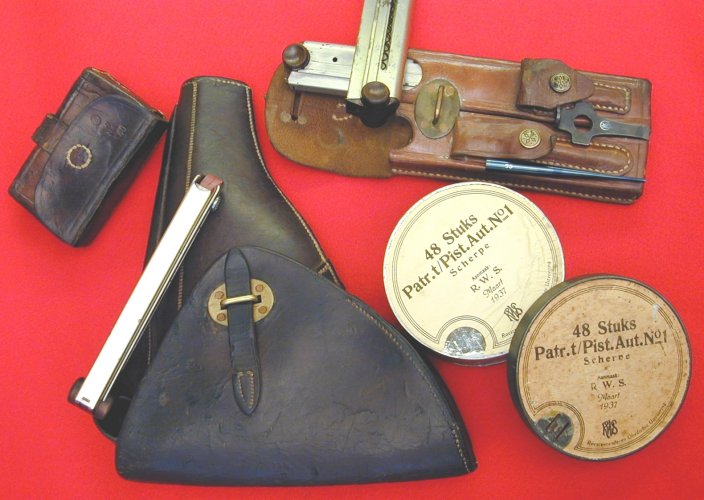
| Figure D1: Dutch holster with twin magazine pouch and 2 magazines, tool punch and Dutch ammunition in sealed tin. The mouse over picture shows the front and back side of the twin magazine pouch. | ||
| ||
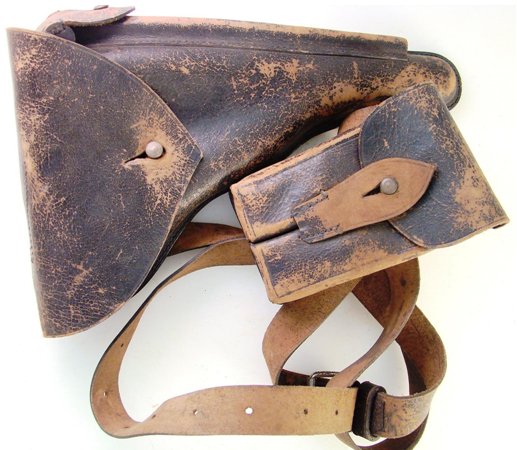
| Figure P1:
Portuguese Navy holster for a 120mm 30 cal barrel Luger.
| ||
| ||
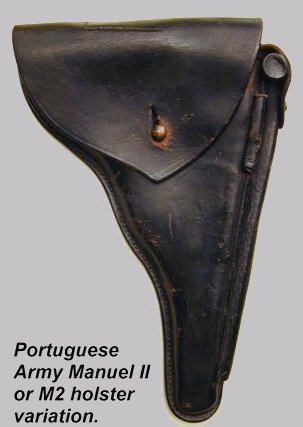
| Figure P2:
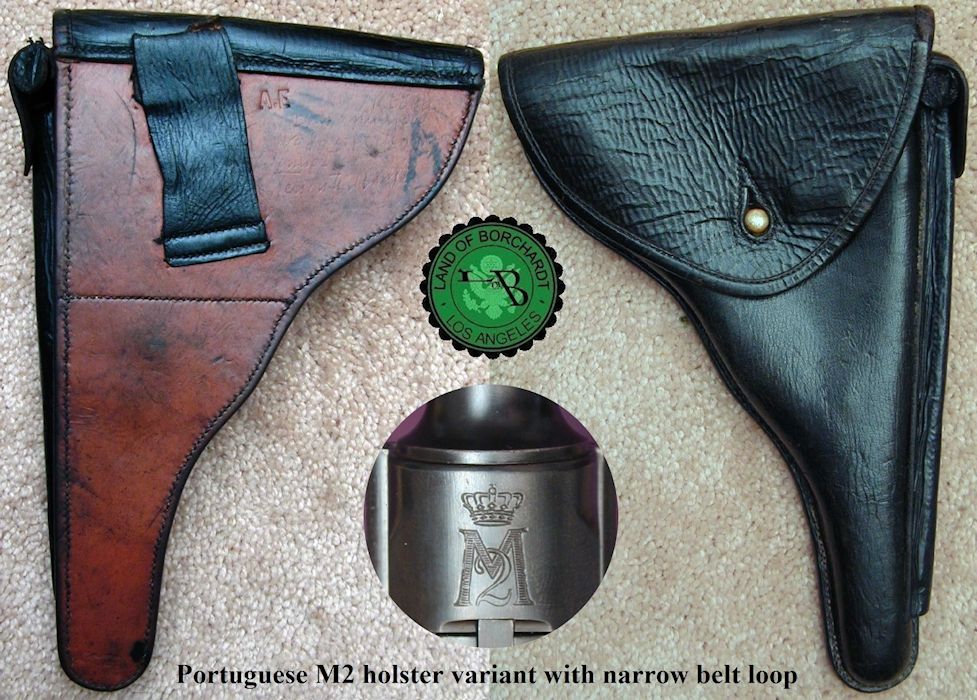
1909 Manuel II or M2 holster, example 1.
| ||
| ||
| Figure P3:
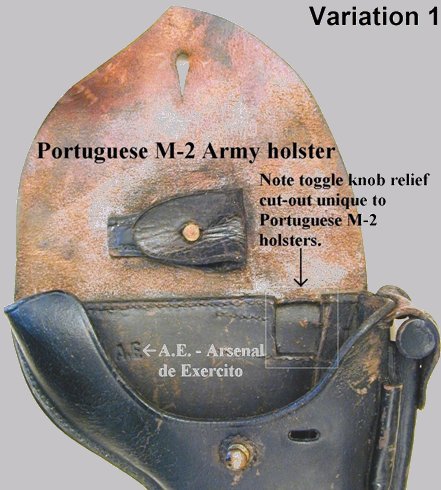
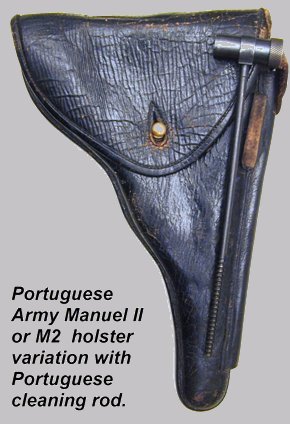
1909 Manuel II or M2 holster, variation 1 with narrow belt loop and without rectangular cutout in holster body for toggle knob.
| ||
| ||
| Figure P4:
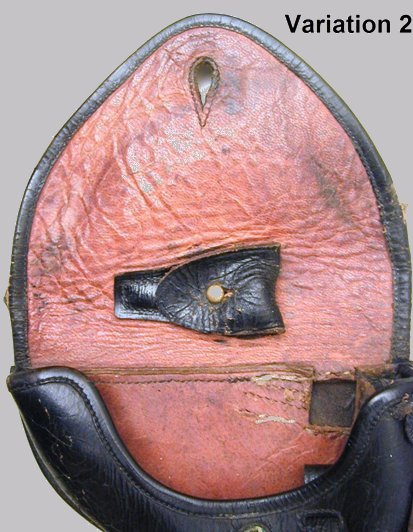
1909 Manuel II or M2 holster, variation 2 with wide belt loop and with rectangular cutout in holster body for toggle knob.
| ||
| ||
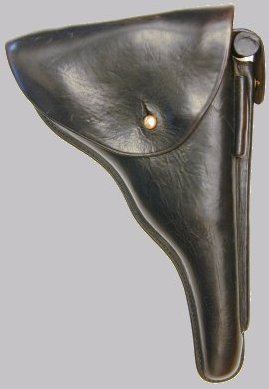
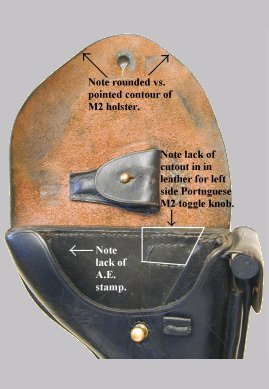
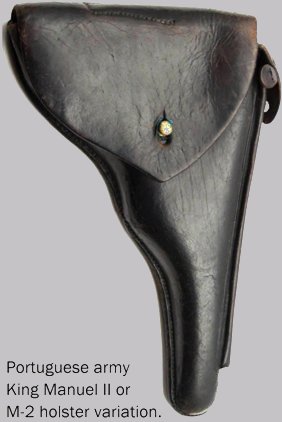
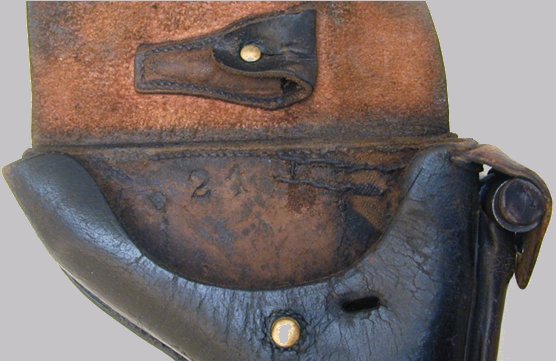
| Figure P5:
1909 Manuel II or M2 holster, variation 3.
| ||
| ||
| Figure P6:
1909 Manuel II or M2 holster, variation 5.
| ||
| ||
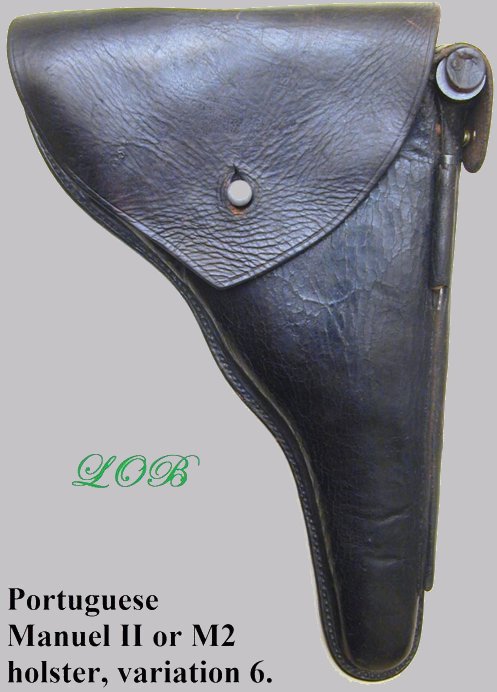
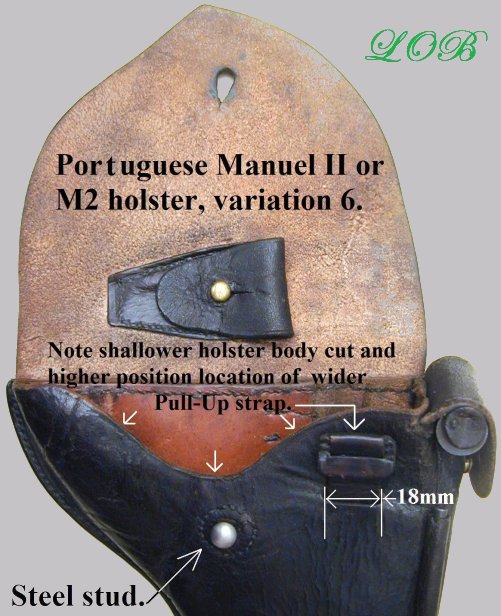
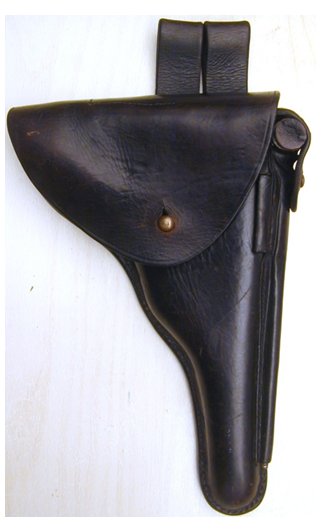
| Figure P7:
1909 Manuel II or M2 holster, variation 6.
| ||
| ||
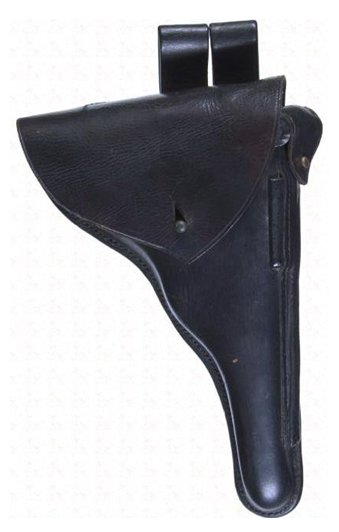
| Figure P8:
GNR holster, variation 2. Click here for more information about the GNR holsters.
| ||
| ||
| Figure P9:
GNR Holster, variation 3. Click here for more information about the GNR holsters.
| ||
| | ||
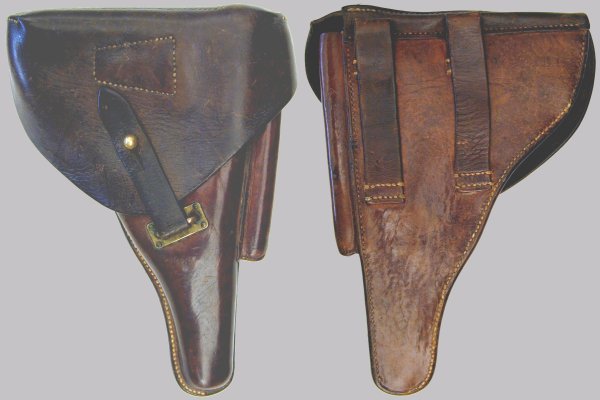
| The Portuguese holster, Figure P7, made for 9mm 10cm barreled Pistolen 08 supplied - with full German HwaA marks - after being rejected by the German authorities, has a deep flap covering nearly half the front surface. An open-top pocket for a reserve magazine is sewn on the spine, while the cleaning rod (type ‘B’) and the combination screwdriver and dismantling tool is carried in pockets stitched inside the flap. The holster is closed in curious style: a long leather strap, stitched to the back of the flap, passes through a brass loop on the body and then up to slip over a brass stud on the upper front of the flap. Mo.943 pistols captured by South African troops in Angola are usually found in holsters of this type. | ||
| ||
| Figure P10:
1943 Portuguese military holster.
| ||
| ||
| Figure P11:
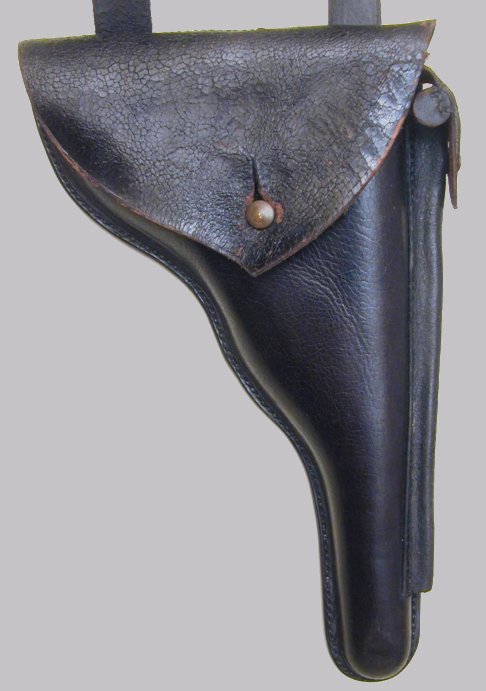
Mystery Portuguese Navy Reject "M2" holster.
| ||